
When most people hear the word parlay, they think of degen sportsbook behavior: wild 10-leg combos, tiny stakes, huge payouts. A product designed to sell the dream of turning $10 into $2,000. That reputation misses the more interesting point. For prediction markets that are not sports-related, parlays are probably the most important missing derivative.
That reputation is, in fact, the current state of parlays and other combination bets. Traditional sportsbooks earn billions a year from sports betting, and combination bets are a large and growing share of it, because people love convex payoffs and long-shot upside. But parlays are not just a gambling product.
Why Single-Event Markets Leave Value on the Table#
Prediction markets today are very good at one thing: pricing single events. Will a candidate win? Will rates get cut? Will Bitcoin finish above a certain level? Will a war escalate?
That alone is powerful. It gives people a way to turn beliefs about the future into prices, and prices into information. But it also forces users to trade one event at a time, even though real-world risk rarely shows up that way.
People do not think in isolated markets. They think in scenarios. If one thing happens, what follows? What gets repriced next? What am I actually exposed to?
The next step for prediction markets is not just listing more contracts. It is giving users better ways to combine them. That is what makes parlays effective. They let people express a more complete view of the world and hedge a specific bundle of risks in a single position. Some venues ship the same idea under a different name, where combo and parlay are naming, not mechanics.
People Think in Scenarios, Not Single Events#
People do not naturally think in isolated yes-or-no questions. They think in connected chains of cause and effect. A single event often leads to many downstream consequences, and people want to capture the second, third and fourth order effects of a single event.
When the Strait of Hormuz was effectively closed in early March, most people immediately jumped to the obvious first-order effect: less oil supply means higher oil prices. And it did. The Dallas Fed put the closure at close to 20% of global oil supply off the market, enough to lift WTI to an average $98 a barrel. But the more interesting view is often in the second and third order effects. A higher oil price can feed into inflation, shift interest-rate expectations, move currencies, and change how other assets reprice.
For example, many people would expect gold to rally during geopolitical stress and times of uncertainty, yet the gold price actually fell after the war with Iran started, as markets focused more on the inflationary shock and the prospect of higher-for-longer Fed rates, which reduced gold's appeal.
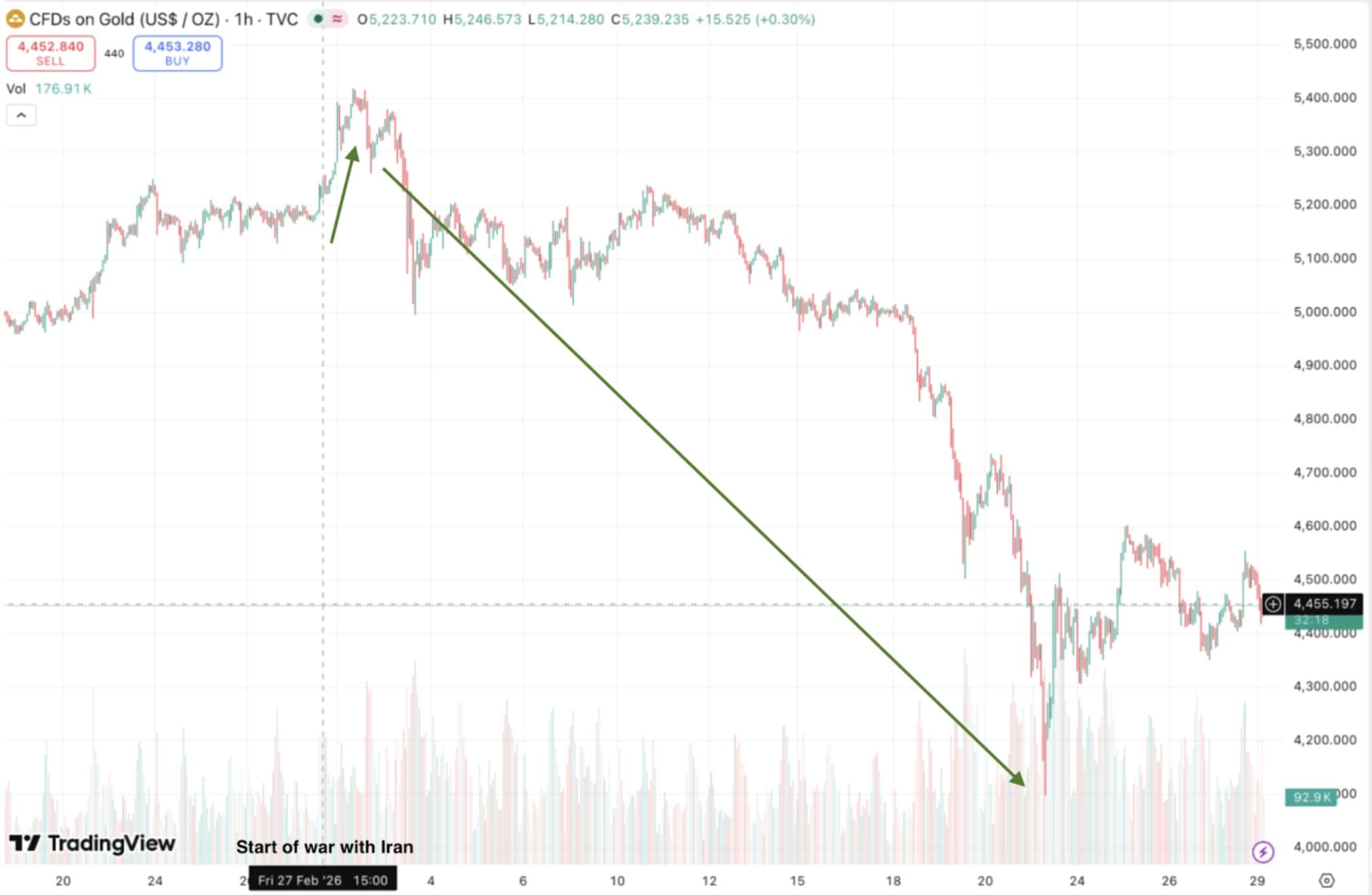
That is exactly the kind of non-obvious causal chain parlays are built to capture. The edge is not just in predicting the headline event, but in predicting how that event propagates through the economy. A parlay lets a trader encode that full thesis in one position: Strait of Hormuz closes, oil rises, inflation expectations rise, rate expectations move up, and gold falls.
If that deeper causal view is right, the parlay's leveraged structure delivers the maximum payoff for being right not just about the shock, but about the way the whole system reprices.
Worked Example: Putting a Causal Chain in One Position#
Take the chain above and price it as a trade. Each link is a contract that already exists somewhere:
- Leg 1: oil finishes the quarter above a given level
- Leg 2: CPI comes in above a given print
- Leg 3: the Fed does not cut at its next meeting
- Leg 4: gold finishes below a given level
Bought separately, that is four positions to size, fund and manage, and three of them can pay while the fourth quietly cancels out the thesis you were trying to express. You end up roughly flat having been mostly right.
As one parlay it is a single position with a single payout. You stake once, market makers quote the combination, and the number reflects how those four legs interact rather than four independent prices multiplied together. If the best quote came back at, say, 12x, then a $100 stake returns $1,200 when the whole chain holds and nothing when any link breaks. Quotes are set by market makers at the time you ask, so treat that multiple as illustrative, not a rate card.
The all-or-nothing shape is the price of the leverage. A parlay is the right instrument when you are confident about the sequence, not just the direction of any one leg.
Every Person and Business Has Its Own Bundle of Risks#
Each person or company is exposed to a different combination of variables, and those variables can move together in ways that increase overall risk. A single prediction market contract usually cannot capture that full exposure. What they need is a way to build a position around their own specific bundle of risks.
Take an airline as an example. Its business is affected by weather disruptions, jet fuel prices, labor conditions and broader travel demand. A bad quarter is usually caused by several of these factors going wrong at once. The airline will care the most about the combined scenario where multiple adverse conditions happen together.
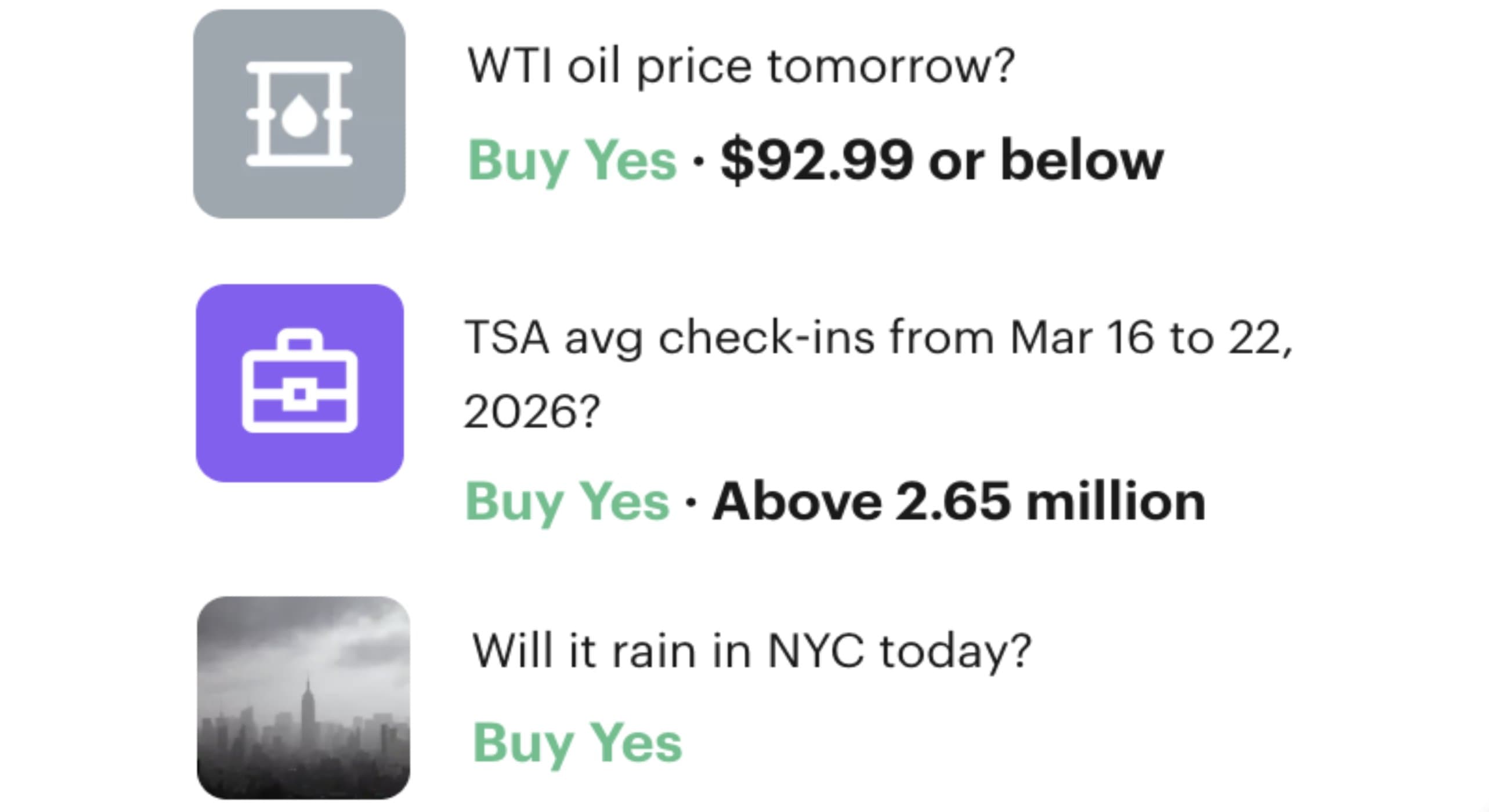
Those legs can span politics, sports, crypto, finance, economics, entertainment, weather and tech, which is what makes a bundle like the airline's expressible at all: the risks it cares about do not sit in one category.
The same idea applies on a personal level. I care about whether the price of Bitcoin goes up, whether gas prices rise, and whether the USD/JPY exchange rate moves, for my upcoming trip to Japan. Because all three affect my spending power, I might want to hedge against all of them at once. Another person may have a completely different set of exposures. Parlays let each user encode their own custom risk profile.
Why Leverage Makes Hedging a Bundle Cheaper#
The key value here is that leverage is naturally embedded into parlays. They make it much more capital efficient for people to hedge against their own specific set of risks, and there is a matching efficiency problem on the other side of the trade, in how much collateral a market maker must lock against the positions it quotes. If the specific combination of outcomes you care about happens, the payoff is concentrated exactly where you need it.
That matters because a bad quarter is rarely one variable going wrong. Hedging each variable separately means paying for protection against outcomes that, on their own, you can absorb. Hedging the combination means paying only for the case that actually hurts, which is why the same protection costs a fraction of the notional.
The shape of the position matters as much as the thesis. Legs settle as one onchain position rather than as separate trades you have to size and manage yourself, and a view that changes before resolution can leave through a cashout auction.
Parlays Are Just the Beginning#
Parlays are the first obvious combo product for prediction markets because of their success in sports betting, but this is only the beginning. Over time, I see prediction markets evolving toward even more combo products like system bets and conditional bundles: more contracts that resolve based on several conditions instead of one. These turn isolated forecasts into more expressive, leveraged predictions.
Who Gets to Author the Combination#
We are already seeing Kalshi explore products like these with the Citrini odds market, which resolves YES if at least three of five macro stress conditions trigger before July 1, 2028, meaning enough evidence, on that market's terms, that AI is causing a global economic crisis. It is a single contract standing in for a whole scenario, but the scenario is one Kalshi chose and wrote the conditions for.
That is the real open question: who gets to author the combination. Today both major venues ship a combo product where the venue defines the menu: Kalshi Combos are built from its own listed contracts, with the exchange deciding which events are eligible and when they appear, and Polymarket Combos are “available on sports markets only” for now. Totalis is built the other way around: you pick the legs, up to five per position, and market makers compete to quote what you built. As the markets mature, we will see fully customizable combinations like these everywhere.
The future of prediction markets will not be betting on one outcome, but on a full chain of related outcomes that together define a worldview. Build a parlay →
FAQ#
Why do parlays matter for prediction markets?#
Single-event contracts price one question at a time, but real exposure is usually a bundle of questions that move together. A parlay lets a trader state a whole scenario as one position, and lets a business hedge the specific combination of conditions that would actually hurt it. That is a different job from the one a single contract does, which is why it is a missing derivative rather than a nicer interface.
What is a scenario parlay?#
A position whose legs are the links in a causal chain rather than unrelated picks. Oil rises, inflation prints hot, the Fed holds, gold falls. The thesis is the sequence, so the payoff should depend on the sequence holding, not on any one leg resolving in isolation.
Can you parlay non-sports prediction markets?#
Only on Totalis. It is the one venue where you can build a parlay outside sports, across politics, sports, crypto, finance, economics, entertainment, weather and tech. The venue-run combo products are sports-first: Polymarket's are “available on sports markets only” for now. That is exactly where the scenario logic in this piece has the most to say, because a causal chain almost never stays inside one category.
How would a business use a parlay as a hedge?#
By buying the combined bad case instead of each variable separately. An airline worried about a quarter where fuel spikes, weather disrupts flights and travel demand softens can hedge that specific conjunction. Because all legs must hit, the position costs a fraction of the notional, and the payoff lands exactly in the scenario that damages the business.
What are system bets and conditional bundles?#
Combination products that relax the all-or-nothing rule. A system bet pays on subsets of the legs, so getting most of the thesis right still pays something. A conditional bundle makes some legs contingent on others resolving first. Both sit between single contracts and strict parlays, and both need a venue willing to price more than one condition at a time.