
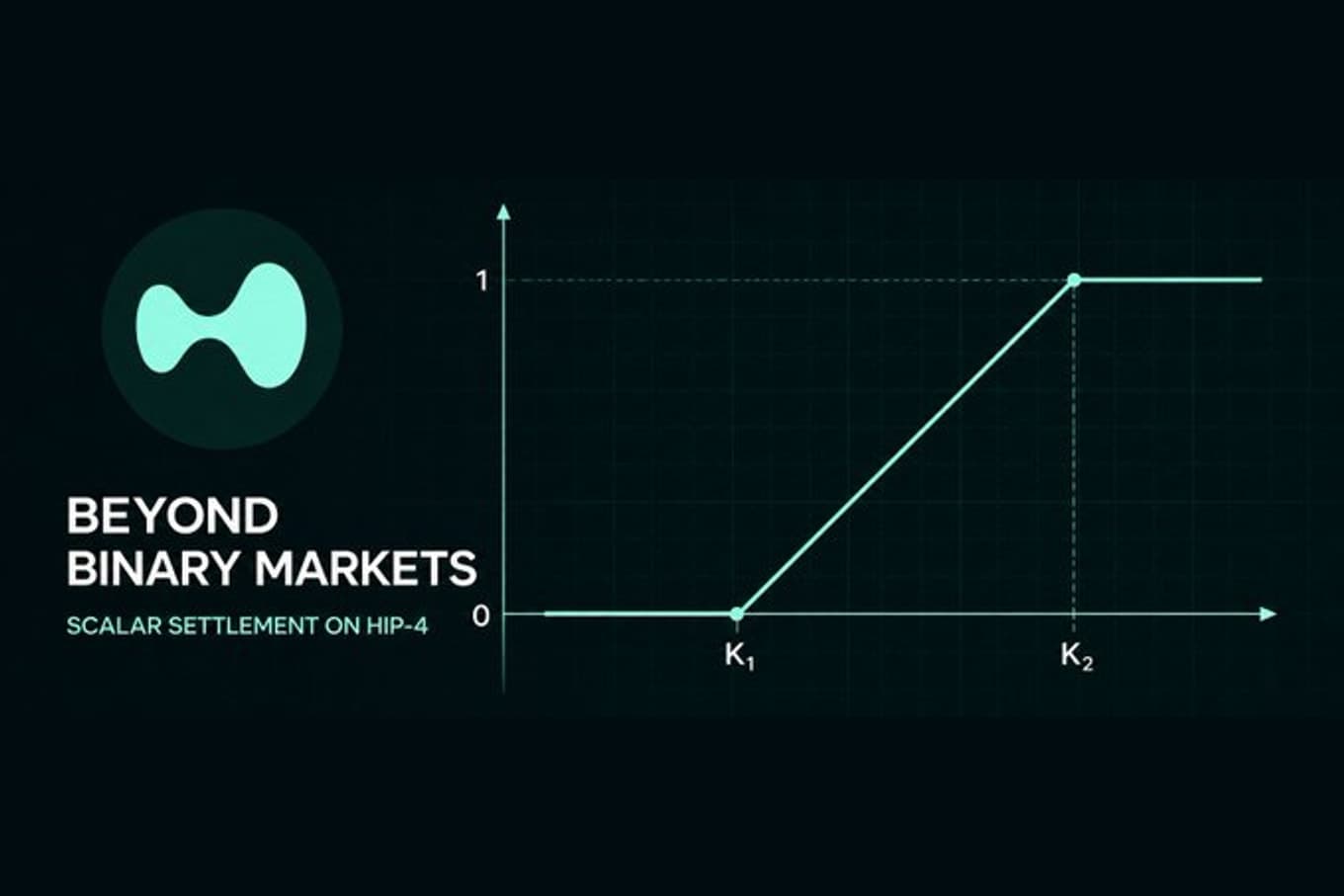
Prediction markets today settle each market at either 1 or 0. That works for categorical questions. But many markets are not about whether something happened, they are about how much, and forcing those questions into binary contracts creates arbitrary thresholds. Scalar settlement removes them.
Now that permissionless HIP-4 deployment is live on mainnet, after the 29 August network upgrade, we are seeing a lot more development with new types of outcome markets. The validator-approved templates include scalar markets: contracts that can settle anywhere between 0 and 1 according to the value of an underlying measure.
Why Binary Settlement Runs Out of Room#
The binary approach makes sense for categorical questions. Did a candidate win? Did a bill pass? Did a team advance? Each has a clean yes or no, and a market priced between 0 and 1 reads directly as a probability.
Many more markets are not really about whether something happened. They are about how much. How high will BTC trade? What will realized volatility be? How many points will a team score? Forcing those into binary contracts creates arbitrary thresholds, and each threshold needs its own order book.
Rather than spreading liquidity across a ladder of binary price thresholds, one scalar contract can express the entire range. Traders get one order book and one settlement rule, so liquidity is not fragmented.
How Scalar Settlement Works#
A binary market uses only the endpoints. Settlement converts Yes to settleFraction quote tokens and No to 1 − settleFraction, with settleFraction at 1 for a binary yes and 0 for a binary no.
A scalar market can use any value between them. If the final result falls halfway through the specified range, the contract settles at 0.5 and the complementary token receives 0.5. The result is a market that pays according to the magnitude of an outcome rather than flipping entirely from zero to one at a single threshold.
Bounded Options#
A call spread is a basic bounded-options strategy. It lowers the upfront premium compared with buying a standalone call, but caps the trader's profit above a chosen price. In traditional options markets a trader builds one by buying a call at a lower strike and selling a call with the same expiration at a higher strike.
Say a trader buys one $100 call for $7 and sells one $110 call for $3. The net cost is $4 per share.
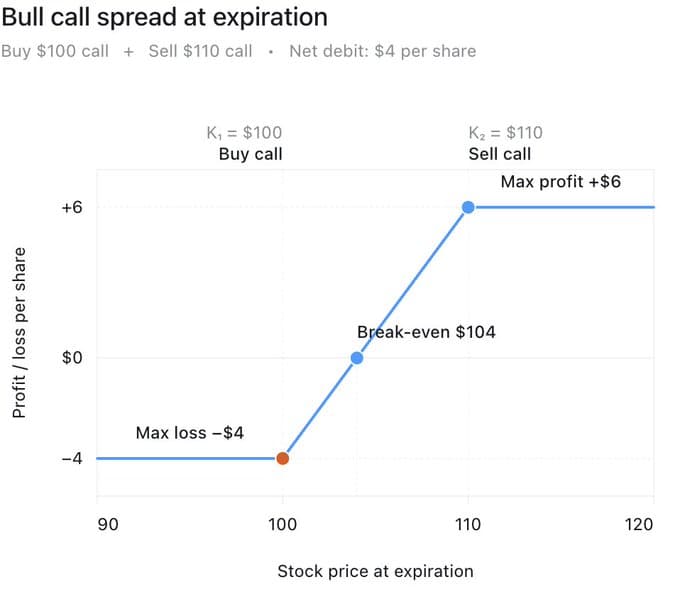
- Below $100, both options expire worthless and the trader loses the $4 premium.
- Between $100 and $110, the position gains value dollar for dollar.
- At or above $110, its value is capped at $10, for a maximum profit of $6 after the entry cost.
The important part is the shape: flat below the lower strike, linear between the strikes, and flat again above the upper strike.
Remove the entry premium and normalize the gross payoff to a range between 0 and 1, and you get the same shape a scalar price template produces:
settleFraction = clamp( (ST − K1) / (K2 − K1), 0, 1 )
S T is the settlement measure, K1 the lower bound and K2 the upper bound.
The market price is what the trader pays to enter the position. The formula determines its terminal payout, not its profit after entry cost.
A Worked BTC Example#
Suppose we create a BTC scalar market with a lower bound of $60,000, an upper bound of $70,000, and the BTC mark price TWAP at expiry as the settlement measure. The Long token settles as follows:
| BTC at expiry | Long settles | Short settles |
|---|---|---|
| At or below $60,000 | $0 | $1 |
| $65,000 | $0.50 | $0.50 |
| At or above $70,000 | $1 | $0 |
This is economically similar to packaging a normalized BTC call spread into one outcome market. A wider range behaves more like capped price participation, while a very narrow range approaches a binary price contract.
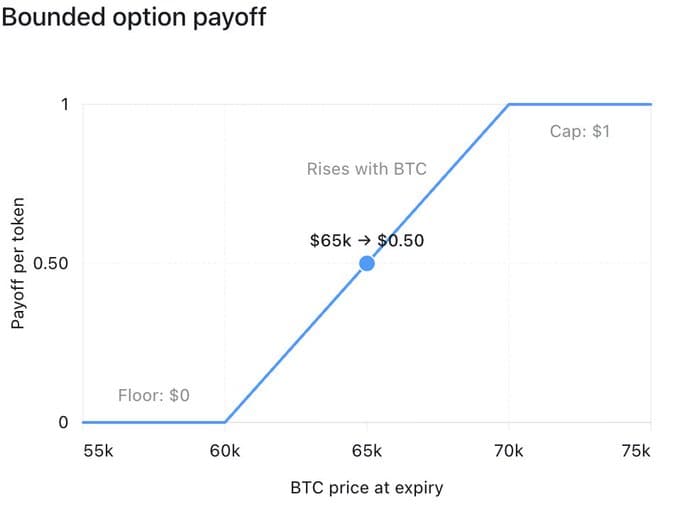
One important implication is that the market price should not always be read as the probability of a single event. In a scalar market it represents the market value of an expected bounded payoff.
Which Markets Benefit Most#
Scalar settlement suits markets where the result is a measurable quantity and the magnitude matters. Markets that are continuous and do not fit categorical outcomes are far better represented this way. The ones I would most want to see:
Volatility measures. A 30-day BTC volatility market settling across a 30% to 70% range. The same structure works for average funding rates, or the basis between spot and perpetual prices.
Macro releases and insurance layers. CPI, payroll growth, policy rates. Traders often care not only whether a release beats expectations but by how much. An insurance contract can begin paying when losses reach an attachment point, increase with the size of the loss, and stop at an exhaustion point.
Sports totals, margins and player props. A basketball total points market running from 200 to 240. The Over token pays $0 at 200 or below, $0.50 at 220, and $1 at 240 or above.
Binary and Scalar Compared#
| Binary markets | Scalar markets | |
|---|---|---|
| Question fit | Whether an event occurs | The magnitude of a measure |
| Payoff shape | One condition decides $0 or $1 | Payout changes gradually across the range |
| Liquidity | Every threshold needs its own order book | Demand across the range sits in one market |
| Execution | A continuous payoff needs a ladder of contracts | The whole payoff trades as one position |
| Information | A threshold reveals one probability | The price reflects the expected bounded payoff |
Portfolio Margining Is Where This Compounds#
Scalar markets have an even bigger capital efficiency advantage once outcome markets become part of a portfolio margin system.
A trader might hold a long BTC perpetual while using the Short side of a BTC scalar market as partial downside protection. Those positions offset some of the same risk. A portfolio margin system that recognizes those offsets across spot, perpetuals and outcome markets makes it materially cheaper to hedge a structured portfolio. That is the same argument as netting collateral across a book rather than reserving against each position alone, applied one level up.
This is a meaningful step, and it differentiates outcome markets on Hyperliquid from venues where every question has to be posed as a threshold. Combined with permissionless deployment, it is a hard trading experience to replicate.
At Totalis we care about it for a specific reason: a parlay is only as expressive as the legs available to build it from. Today every leg resolves to a yes or a no, so the position pays in full or not at all once all of its legs settle. Scalar legs would let a position say how far, not just whether, which is a wider class of view than an all-or-nothing combination can carry. Build a parlay →
FAQ#
What is a scalar prediction market?#
A contract that settles anywhere between 0 and 1 according to the value of an underlying measure, instead of resolving to one or zero. If the measure lands halfway through the market's range, the contract settles at 0.5 and the complementary side takes the other 0.5.
How is a scalar market different from a binary one?#
A binary market uses only the endpoints and answers whether something happened. A scalar market uses the values in between and answers how much. In practice the difference shows up as liquidity: a continuous payoff built from binaries needs a separate order book at every threshold, while a scalar market concentrates the whole range in one.
Is a scalar market the same as an option?#
It has the same payoff shape as a call spread: flat below the lower bound, linear between the bounds, flat above the upper one. Normalize a call spread's gross payoff to a 0 to 1 range and you get the scalar settlement formula. The difference is that the market price, not a premium, is what you pay to enter.
Does the price of a scalar market still mean a probability?#
No, and this trips people up. In a binary market the price reads as the probability of the event. In a scalar market it is the market value of an expected bounded payoff across the range, which is a different quantity.
Which markets are best suited to scalar settlement?#
Anything where the number itself carries the information rather than whether an event occurred: volatility, funding rates, basis, macro releases like CPI and payrolls, insurance layers with an attachment and exhaustion point, and sports totals, margins and player props.
What happens at the edges of the range?#
The payoff clamps. Below the lower bound the Long side settles at 0 and the Short side at 1; above the upper bound those reverse. That is what makes the position bounded, and it is why a wide range behaves like capped participation while a narrow one converges on a binary contract.