Prediction markets are more than YES and NO buttons
9 min read
By Carson, founding engineer at Totalis. We build the combo platform for prediction markets on Hyperliquid.

A prediction market sells you a claim. One share of YES on "City beats United" pays $1 if it happens and $0 if it does not. Price is the crowd's probability. That is the whole product most people see, and it is why most people file prediction markets next to sportsbooks.
They are wrong, and the mistake is expensive. The buy button is the smallest part of the system. Under it sits a small algebra of claims and a set of roles that no sportsbook has. The fight between venues has nothing to do with fees or frontends either.
The roles nobody sees#
The casino framing needs a house. Prediction markets do not have one. They have a supply chain.
Deployers create markets. On HIP-4 that is not a form anyone fills in. A deployer stakes 500k HYPE, around $40M at today's price, for at least 183 days. Then they deploy from templates validators voted on, set their own fee scale, and settle their own outcomes.
Deploying costs no gas. Capacity is capped per deployer, not priced. The closest analogy is an exchange listing a futures contract with its own capital behind it, and taking a cut of every closing fee in return.
Market makers quote both sides. On every major venue, the YES book and the NO book are the same book seen from two sides. Buying YES at 0.60 is selling NO at 0.40. The maker rents inventory and collects the spread. Whether the outcome hits is somebody else's problem.
Arbitrageurs enforce the math. Every exhaustive set of outcomes must sum to $1. When it does not, someone buys the whole set below a dollar or sells it above one. An AFT 2025 paper on Polymarket estimated around $40 million extracted this way over its measurement window. No house paid that out. Traders who left a set priced away from a dollar did.
Builders own the users. Hyperliquid pays builder codes on sells. Polymarket pays builder fees and maker rebates. A frontend here has its own revenue line. Totalis, the app we build on HIP-4, charges a 0.1% builder fee on single-market orders and its own fees on Combos.
Then there is the layer almost nobody talks about.
A share is a claim with algebra#
For one outcome X:
YES X + NO X = $1
For a question with outcomes A, B, C that are exhaustive and mutually exclusive:
YES A + YES B + YES C = $1
Combine them and you get the identity that makes multi-outcome markets
interesting:
NO X = YES of every other outcome
These hold at settlement no matter what the books say. Prices can wander. Payoffs cannot. The question a venue has to answer is whether it lets you act on them before settlement.
HIP-4 gives you four native operations:
splitOutcome: $1 into YES X + NO X
mergeOutcome: YES X + NO X into $1
negateOutcome: NO X into YES of every other outcome in the question
mergeQuestion: YES of every outcome into $1
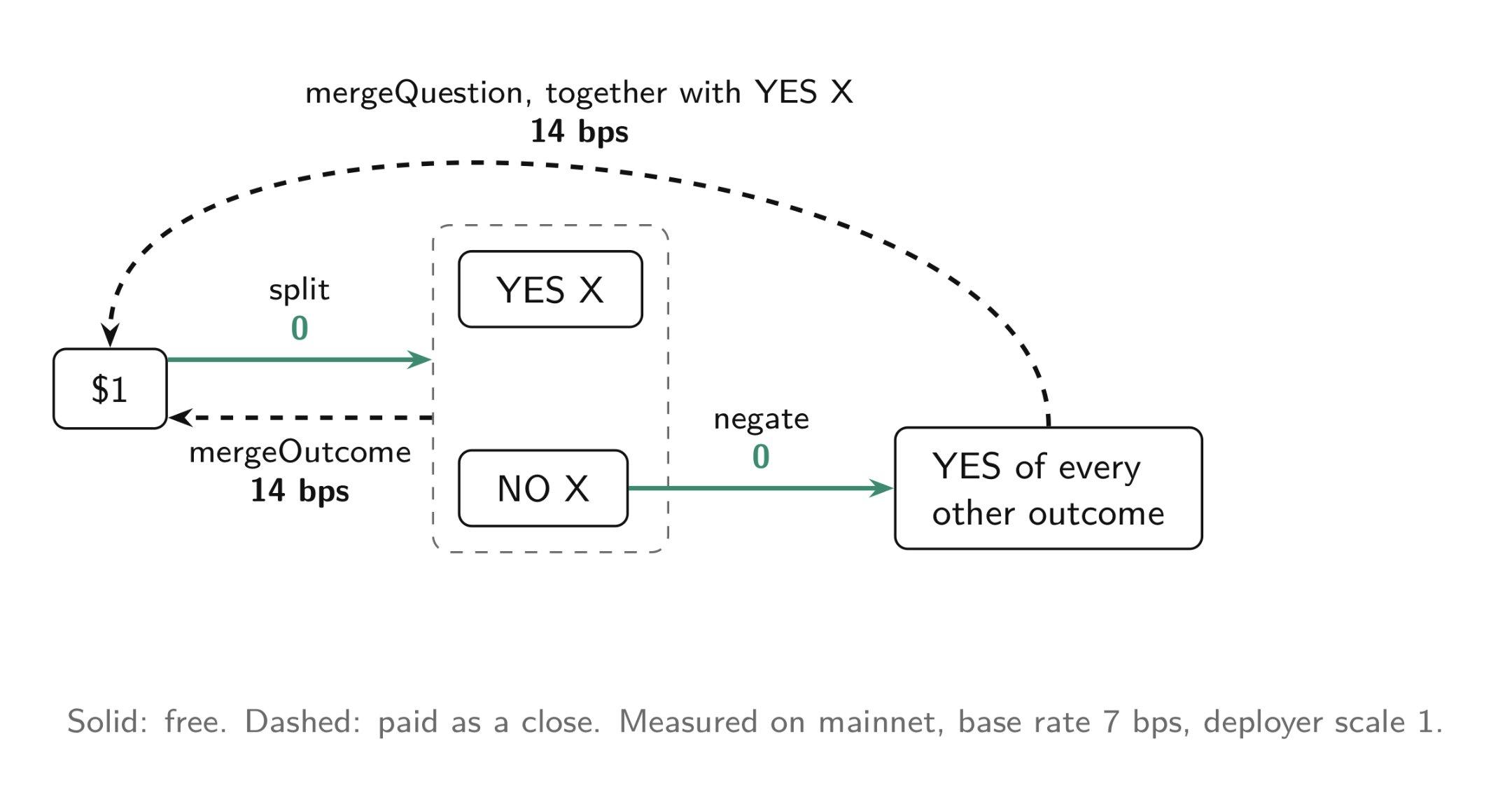
That is everything a user can do. No leverage. No funding. No liquidation. Full collateral, four transformations, one merged order book per outcome. When a YES buyer meets a NO buyer in that book, HyperCore mints a pair. When two sellers meet, it burns one.
Small set. Every piece is load bearing.
Where the money is#
Take the live books for every three-option question on mainnet, eighteen of them at the time of writing. For each, compare selling a NO position directly against converting it with negateOutcome and selling the resulting YES legs.
Manchester United vs Manchester City, 1,000 shares of NO United. Direct sale: $656.92. The direct book had 940 shares of real bids, then dropped to $0.00009. Convert instead: sell 1,000 YES City for $459.43, sell 1,000 YES Draw for $243.11, total $702.54. Same settlement exposure, $45 more cash, and no cliff.
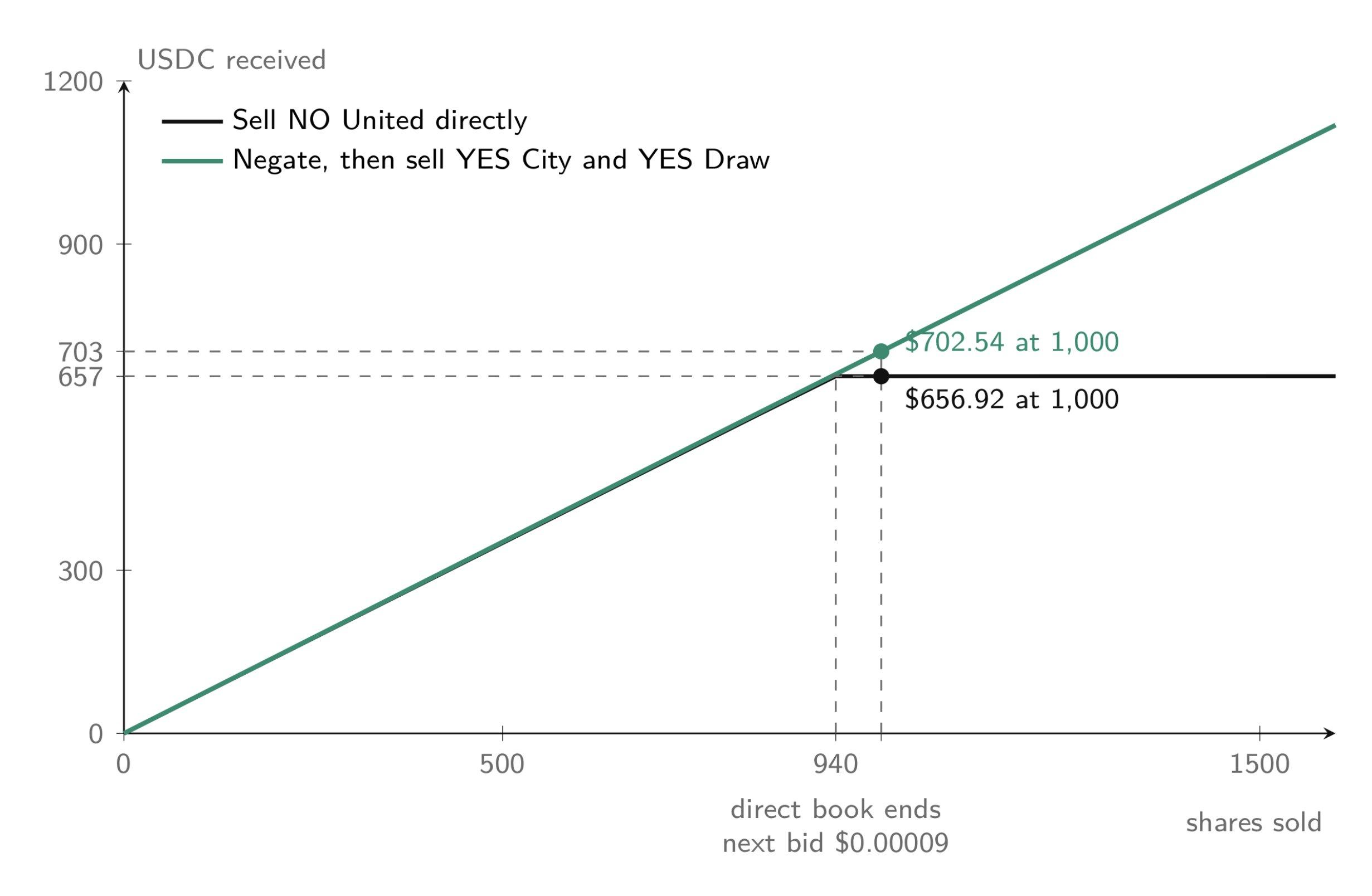
The point is not the $45. The point is that three order books for the same question had three different depth profiles, and the conversion routes across all of them. A trader who only sees the button on their own market eats the cliff.
The conversions themselves, measured with 1 USDC on mainnet:
splitOutcome: 0
negateOutcome: 0
mergeOutcome: 14 bps
mergeQuestion: 14 bps
Expanding a position is free. Collapsing one is paid. HIP-4 only charges when you close or settle, never when you open, and a merge counts as closing. The base outcome rate at the lowest volume tier is 7 bps, and this question's deployer fee scale of 1 doubles it.
Read that as policy, not as a fee table. Hyperliquid pays you to spread liquidity across linked books and charges you to pull it back out. Whether that is good design is a fair fight. The case for it is that it keeps makers on the thin books.
For a market maker this changes the job. You can quote YES on three outcomes and hedge with a single NO, because negate turns them into each other for free. You can hold a paired position as inventory and only pay when you finally merge. Your inventory is fungible across the question in a way it never is on a venue that treats each market as an island.
For an arbitrageur, the interesting route is one Polymarket cannot do. Polymarket's Negative Risk adapter converts NO into other YES. It does not go the other way. Hold a complete YES basket minus one outcome and you wait for settlement. On HIP-4 you split $1 into YES X and NO X, merge the now complete YES set through mergeQuestion, and walk away holding NO X. Two actions, one merge fee, no waiting. A recent TUM preprint measured this exact asymmetry on Polymarket and found $1.086 million extracted through the supported direction versus $32 thousand through the unsupported one. The direction the protocol exposes is the direction that gets enforced.
The real fight between venues#
Everyone frames Hyperliquid vs Polymarket vs Kalshi as UI, fees, and liquidity. Those matter, and they are the least interesting part.
All three venues encode the same payoff identities. They differ in when the trader gets to touch them.
HIP-4 exposes them at order time. Split, negate, merge, question merge are native actions you call whenever you want. The merged YES/NO book means you never choose a venue for the complement. HyperCore mints and burns pairs inside matching.
Polymarket exposes them at position time. Its Conditional Token Framework gives you split, merge, and redeem as Polygon contract calls. Its CLOB also mints and burns pairs when complementary orders cross, and Negative Risk converts NO into other YES. In one place it goes further than HIP-4. You can feed several NO positions into one atomic conversion and get collateral plus the remaining YES basket back in a single transaction. HIP-4 needs a negate followed by merges to reach the same state, and pays a merge fee per dollar released. Polymarket's positions are also plain ERC-1155 tokens you can move anywhere. HIP-4 tokens live on HyperCore. HyperEVM can call them through CoreWriter, but the docs do not promise general transferability.
Kalshi exposes them at margin time. There is no split, merge, or negate to call. Same-market YES and NO net automatically. Across markets, an opt-in feature called Collateral Return recognizes that two NO positions on mutually exclusive outcomes guarantee at least $1 and lowers your required collateral by that much. Your positions do not change. Your margin does. It is off by default, and once you place your first order in an event, your eligibility for that event is locked, filled or not.
Same math, three placements. HIP-4 transforms positions. Polymarket transforms tokens. Kalshi transforms collateral requirements.
Now the fee comparison, because the numbers are crazy. Polymarket and Kalshi published the same taker fee formula: shares times a rate times price times one minus price. Kalshi's general rate is 0.07. Polymarket's crypto category is 0.07. At a 50 cent price that is 1.75 cents per contract, about 3.5% of notional. HIP-4 at fee scale 1 charges 0.14% on closing, nothing to open. On a $50 position that is $1.75 against $0.07.
The caveat: fee scale is the deployer's call, up to 10, which puts the closing fee at 20x base. The cheap number above is one venue's choice, not a protocol guarantee.
Makers are the other side of that coin. Polymarket pays maker rebates and liquidity rewards from the platform. HIP-4 pays outcome makers nothing, not even the spot rebate. That job moves to the deployer, who has a fee share to spend on it, and one deployer already runs a $1M daily rewards pool for resting orders near the price. If you make markets for a living, the question is not whether the protocol pays you. It is which deployer does.
Then the part that is not about money. Who settles.
On Polymarket, UMA's optimistic oracle does, with a bond, a dispute window, and a vote if it escalates. On Kalshi, the exchange does, under CFTC rules. On HIP-4, the deployer does, inside a template validators approved, with 500k HYPE that validators can slash if the market contradicts what the template says it means.
The regulated one is the slowest to list and the hardest to get wrong. The oracle one is the most decentralized and has a public history of fights. The deployer one is different in kind. HIP-4 fixes what a market means and who has capital at risk. It does not fix the process. One venue can settle from a data feed. Another can run a dispute window, or put contested results to a vote, or copy UMA wholesale. Two venues on the same chain can disagree on how truth gets decided. A Totalis Combo, which holds 2 to 5 HIP-4 outcomes in one position, settles from each leg's HIP-4 result, so it inherits however each leg's market gets settled.
Nobody gets all three. HIP-4 is the only one that lets the venue pick.
Where HIP-4 is not there yet#
The foundation is not finished, and the market on top of it is small.
Three deployers on mainnet. About 190 live outcomes between them, most of them sports and short-dated price binaries. Polymarket lists that many markets in a busy week. Depth is thin on most books and the United example above hit a cliff at 940 shares. The number grows every day, and the 500k HYPE bar means each new deployer is a serious operator, but today this is an early venue with a handful of serious participants, not a liquid market.
Conversions are not atomic with the sales that follow them. Negate, then sell two legs, is three actions. The book can move between them. Polymarket's contract-level batching has the same problem at the CLOB boundary, so nobody has solved this, but HIP-4 could.
Acknowledgements from userOutcome actions carry no operation ID. Anyone building on this has to journal their own intent and reconcile against fills, or they will double-convert someone one day.
And there is no atomic reverse negate. The synthetic route works and costs a merge fee. A native one would close the asymmetry Polymarket has not closed either.
Foundation, not product#
Polymarket and Kalshi are products. You open them and trade. HIP-4 is four operations, one merged book, a fee rule, and a deployer system, sitting inside a chain that already runs perps and spot. It does less than either competitor on purpose.
The pieces it does have show their reasoning. Free expansion, paid consolidation. A merged book that removes the complement venue problem entirely. Fees only on closing. Every one of those is a choice someone argued about.
That is what a foundation looks like. It is also why the interesting work is not done. The terminals, the routers that pick negate over a thin book, the makers that treat a whole question as one inventory, the deployers who list things nobody else will. None of that exists yet at the scale it will. The protocol has to keep shipping the base. Builders have to make it usable without hiding what is underneath.
If you trade prediction markets and only ever pressed buy and sell, you have been using a fraction of the asset. If you build one and only wired up buy and sell, you shipped a fraction of the venue.
This article is for informational purposes only and is not financial advice. Prediction market positions can lose their entire value. Availability of markets and features depends on your jurisdiction and each platform’s terms.