Kalshi fees explained: what you pay per contract in 2026
9 min read
By the Totalis team. We build the combo platform for prediction markets on Hyperliquid.
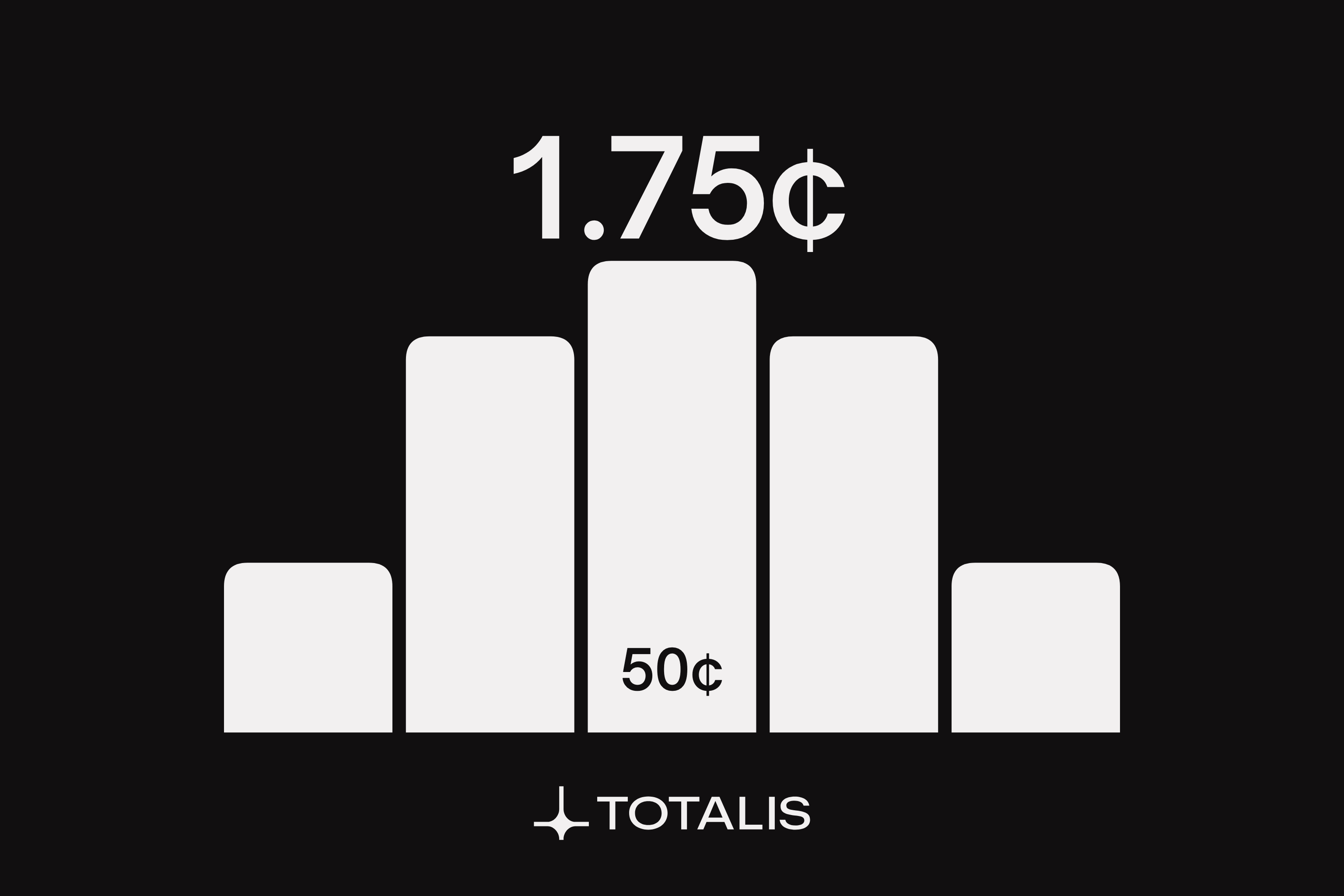
Kalshi charges a trading fee of 0.07 × C × P × (1 − P), where C is the number of contracts and P the price in dollars. That is at most 1.75 cents a contract, at a price of 50 cents, and less toward 1 cent or 99 cents. Only the side whose order fills against the book pays it, except on markets that also charge makers. There is no fee to settle, no membership fee, and no fee on bank (ACH) transfers. Card deposits can cost up to 2%.
Contents
This page explains costs; it isn't financial advice.
How are Kalshi fees calculated?#
Kalshi's fee schedule charges a percentage of each contract's expected earnings: the most it can pay, times the chance the price implies. In dollars:
fee = round up(M × 0.07 × C × P × (1 − P))
C is the number of contracts, P the price in dollars (50 cents is 0.5) and M the market's multiplier, 1 unless Kalshi lists another.
Three things follow from the formula:
- The fee peaks at 50 cents. P × (1 − P) is largest at 0.5, so a coin-flip contract costs the most to trade.
- It is the same on both sides of a price. Buying Yes at 30 cents costs the same fee as buying at 70 cents.
- Only the order that takes liquidity pays. Kalshi's schedule says fees are charged on orders that match immediately against the order book. A resting order pays nothing, unless the market is one of those with maker fees.
Kalshi's help center says transaction fees are how Kalshi makes money, not positions on outcomes.
Kalshi fees per contract: 1 cent to 99 cents#
Standard markets, multiplier 1, for an account that trades with Kalshi directly. Every fee is rounded up to $0.0001, the precision explained below, and the last column is the taker fee on 100 contracts as a share of what you pay.
| Price | Taker fee per contract | Taker fee, 100 contracts | Maker fee, 100 contracts (where charged) | Taker fee as share of cost |
|---|---|---|---|---|
| 1¢ | $0.0007 | $0.0693 | $0.0174 | 6.93% |
| 5¢ | $0.0034 | $0.3325 | $0.0832 | 6.65% |
| 10¢ | $0.0063 | $0.63 | $0.1575 | 6.30% |
| 20¢ | $0.0112 | $1.12 | $0.28 | 5.60% |
| 25¢ | $0.0132 | $1.3125 | $0.3282 | 5.25% |
| 30¢ | $0.0147 | $1.47 | $0.3675 | 4.90% |
| 40¢ | $0.0168 | $1.68 | $0.42 | 4.20% |
| 50¢ | $0.0175 | $1.75 | $0.4375 | 3.50% |
| 60¢ | $0.0168 | $1.68 | $0.42 | 2.80% |
| 70¢ | $0.0147 | $1.47 | $0.3675 | 2.10% |
| 75¢ | $0.0132 | $1.3125 | $0.3282 | 1.75% |
| 80¢ | $0.0112 | $1.12 | $0.28 | 1.40% |
| 90¢ | $0.0063 | $0.63 | $0.1575 | 0.70% |
| 95¢ | $0.0034 | $0.3325 | $0.0832 | 0.35% |
| 99¢ | $0.0007 | $0.0693 | $0.0174 | 0.07% |
Kalshi's schedule contradicts itself on rounding. Its formula rounds "such that the fee + positionCost is rounded to a centicent", that is to $0.0001, and Kalshi's fee rounding docs say balances of members who trade with Kalshi directly are kept to that precision. The schedule's own fee table rounds up to whole cents instead: $0.02 for one contract at 50 cents, $0.34 for 100 contracts at 5 cents. Whole cents are what the docs apply to members who are not direct, such as those who clear through a broker. On that basis a single contract at 50 cents costs 2 cents, not 1.75, and small orders pay more.
Kalshi maker fees: do limit orders pay?#
Usually not. A limit order that rests on the book and fills later pays nothing on most markets. On markets with maker fees, Kalshi's fees page says a resting order pays when it fills, and canceling it is free. The maker rate is a quarter of the taker rate:
maker fee = round up(M × 0.0175 × C × P × (1 − P))
Applies only to series Kalshi lists with maker fees. The schedule sets M to 0 everywhere else.
That is at most $0.4375 per 100 contracts. On 11 November 2026, 160 Kalshi series carried maker fees, 107 of them sports. They include NFL, NBA, college football and NHL games, Premier League and Champions League games, the Super Bowl, Fed decisions, CPI and jobs reports. Kalshi's fee schedule page lists them with their fee ranges.
Which Kalshi markets have different fees?#
Kalshi gives each series a fee type and a multiplier. Across all 16,078 series Kalshi listed on 11 November 2026:
| Fee setting | Series | Examples |
|---|---|---|
| Standard taker fee, no maker fee | 15,883 | Most markets |
| Taker fee plus maker fees | 160 | NFL games, Fed funds rate, CPI |
| Half multiplier before the game (M = 0.5) | 19 | Baseball game, spread, total and player prop series |
| Fee-free (M = 0) | 14 | BTC and ETH year-end price ranges, some long-dated politics and economics markets |
| Combo maker fees | 3 | Multi-game and cross-category combo series |
One baseball series has both maker fees and the half multiplier, so it appears twice. The live fee schedule page shows the baseball multiplier as "0.5 prelive, 1 live": half the fee until the game starts, the full fee once it is in play. The 7 July PDF doesn't mention the pre-game discount and lists the main baseball game series at 1, so the live page is the newer source.
What a real Kalshi trade costs after fees#
At 10:07 UTC on 11 November 2026, Kalshi's 49ers vs Cowboys market showed the 49ers to beat the Cowboys on 15 November at a 66-cent bid and a 67-cent ask. NFL games are a maker-fee series. Buying 100 contracts:
| Buy now at the 67¢ ask (taker) | Rest a bid at 66¢ (maker, if it fills) | |
|---|---|---|
| Price paid | $67.00 | $66.00 |
| Fee | $1.5477 | $0.3927 |
| Total cost | $68.5477 | $66.3927 |
| Profit if the 49ers win | $31.4523 | $33.6073 |
| Loss if they lose | $68.5477 | $66.3927 |
The fee moves the break-even from 67% to about 68.5%: the 49ers have to win more often than that for the taker trade to pay over time. The maker order saves about $2.16 here, $1.00 from buying a cent lower and $1.16 in fees, but only if someone sells to it. Selling the position before the game is a second taker fee, $1.12 if you sold at 80 cents. Holding to settlement costs nothing more. For how prices turn into payouts, see prediction market odds and payouts.
Kalshi fees vs Polymarket#
The same game, the same 100-contract taker buy, read within the same minute from the Polymarket international market and the Polymarket US order book. Fees are rounded to the cent:
| Venue and tier | Best ask | Taker fee | Total cost | Profit if the 49ers win |
|---|---|---|---|---|
| Kalshi | 67¢ | $1.55 | $68.55 | $31.45 |
| Polymarket (international) | 66¢ | $0.67 | $66.67 | $33.33 |
| Polymarket US, first 7 days | 66.25¢ | $1.55 | $67.80 | $32.20 |
| Polymarket US, under $10,000 a month, per its docs | 66.25¢ | $2.12 | $68.37 | $31.63 |
| Polymarket US, under $10,000 a month, per its CFTC filing | 66.25¢ | $2.62 | $68.87 | $31.13 |
Polymarket's international exchange set this NFL market's fee rate at 0.03, but US traders can't open positions there. Polymarket's developer geoblock page calls the US close-only, while its help center, updated 29 October 2026, lists it as completely restricted. Polymarket US charges by 30-day volume, and its published fee schedule and its 10 November filing with the CFTC give different rates for most tiers, so its low-volume figure could be either. Polymarket fees covers both schedules, including how a new account's first week sets its tier until day 30. Lowest-fee prediction markets runs 11 venues through the same formula, and Hyperliquid vs Polymarket vs Kalshi compares more than fees.
Kalshi combo fees#
A combo is its own market with its own order book, per Kalshi's combos page, so it pays the same taker formula on the combo's price. The difference is on the other side. Kalshi's fee schedule page charges combo makers half the taker fee, except on uncorrelated NFL combos. At $0.0001 precision:
| Combo price | Taker fee, 100 contracts | Maker fee, 100 contracts |
|---|---|---|
| 10¢ | $0.63 | $0.315 |
| 25¢ | $1.3125 | $0.6563 |
| 50¢ | $1.75 | $0.875 |
Who counts as the maker follows the quote, not the order book. In a July 2026 filing with the CFTC, Kalshi set combo fees so that a trader who accepts a quote pays the taker fee and the quoter pays the maker fee. For leg limits, quotes and early exits on every venue that offers combos, see prediction market combos compared.
Kalshi deposit and withdrawal fees#
From the fee schedule PDF and Kalshi's help pages, as of 11 November 2026:
| Method | Deposit | Withdrawal |
|---|---|---|
| Bank transfer (ACH), US only | Free | Free |
| Debit card | Up to 2% | Free, per the debit card withdrawals page |
| Wire | No Kalshi fee; your bank may charge; $1,000 minimum | Only for amounts over $500,000 |
| Crypto | Provider and network fees may apply, per the crypto deposits page | Provider fees may apply |
The schedule also reserves the right to charge 0% to 2% on any payment rail. Kalshi's international page says traders outside the US can use debit cards, wires and crypto, not ACH, PayPal or Venmo. A broker you reach Kalshi through can add its own fees. How Kalshi works covers accounts and funding.
Why is the Kalshi fee so high?#
On a per-contract basis it is small, never above 1.75 cents on a direct account. It feels high for three reasons:
- It is a big share of a cheap contract. The fee is 7% × (1 − P) of what you pay. At 5 cents that is 6.65% of your stake.
- It is a big share of a favorite's upside. The fee is also 7% × P of what you can win. Buying at 90 cents, $0.63 of fees on 100 contracts takes 6.3% of the $10 you stand to make.
- You often pay it twice. Taking liquidity to get in and again to get out doubles the fee, and each crossing also pays the spread.
The last two points are why fees matter most to people who try to make money on prediction markets by buying heavy favorites, and to arbitrage between venues, where a few cents of edge disappear after two taker fees.
How to avoid fees on Kalshi#
You can't avoid them everywhere, but you can pay much less:
- Use limit orders. On the 15,883 standard series a resting order that fills pays no fee. On maker-fee series it pays a quarter of the taker fee.
- Hold to settlement. Kalshi charges no settlement fee, so letting a contract expire avoids the exit fee.
- Fund by ACH. Bank transfers are free; cards can cost up to 2%.
- Check the market's fee before trading. Baseball series charge half before the game starts, and 14 series charge nothing. Each series'
fee_typeandfee_multiplierfields in the API say which applies (Kalshi API guide). - Trade with Kalshi directly. Direct balances round to $0.0001; whole-cent rounding costs most on small orders.
Kalshi perpetual futures fees#
Kalshi's perpetual futures have a separate schedule in the same PDF, in basis points of notional and tiered by 30-day perps plus prediction volume:
| 30-day volume | Taker fee | Maker fee |
|---|---|---|
| Under $100,000 | 12.0 bps | 5.0 bps |
| $1 million and up | 6.0 bps | 2.4 bps |
| $3 billion and up | 2.6 bps | 0.6 bps |
These are 3 of 11 tiers; the fee schedule PDF lists them all.
Prediction market fees outside the US#
Kalshi accepts traders from many countries, but not all. Prediction markets on Hyperliquid are one route for people it doesn't serve. Totalis trades Hyperliquid's HIP-4 outcome markets as singles or as Combos of 2 to 5 legs. Per its fees and limits page, singles in the app pay a 0.1% builder fee on filled value plus Hyperliquid's own outcome fee, Combos pay 1.5% of stake at entry and 1% of profit on a win, and deposits and withdrawals carry no Totalis fee. Makers quote each Combo, and you can ask them to buy one back before it settles. Totalis is not available to US persons, and signing up takes an invite code. Compare a quote on Totalis. For Hyperliquid's own rates, see Hyperliquid fees explained, and for other venues, Kalshi alternatives.
FAQ#
Is Kalshi free to use?#
Opening an account, holding contracts, settling them and moving money by ACH cost nothing. Trading does: takers pay on every fill, and makers pay on the series that charge them.
Can I see the fee before I place a trade?#
Yes. Kalshi's fees help page says the fee shows when you click the "i" icon next to "You're buying" on the order ticket.
This article is for informational purposes only and is not financial advice. Prediction market positions can lose their entire value. Availability of markets and features depends on your jurisdiction and each platform’s terms.