Prediction market arbitrage: how it works on Polymarket and Kalshi, and why it rarely pays
10 min read
By the Totalis team. We build the combo platform for prediction markets on Hyperliquid.
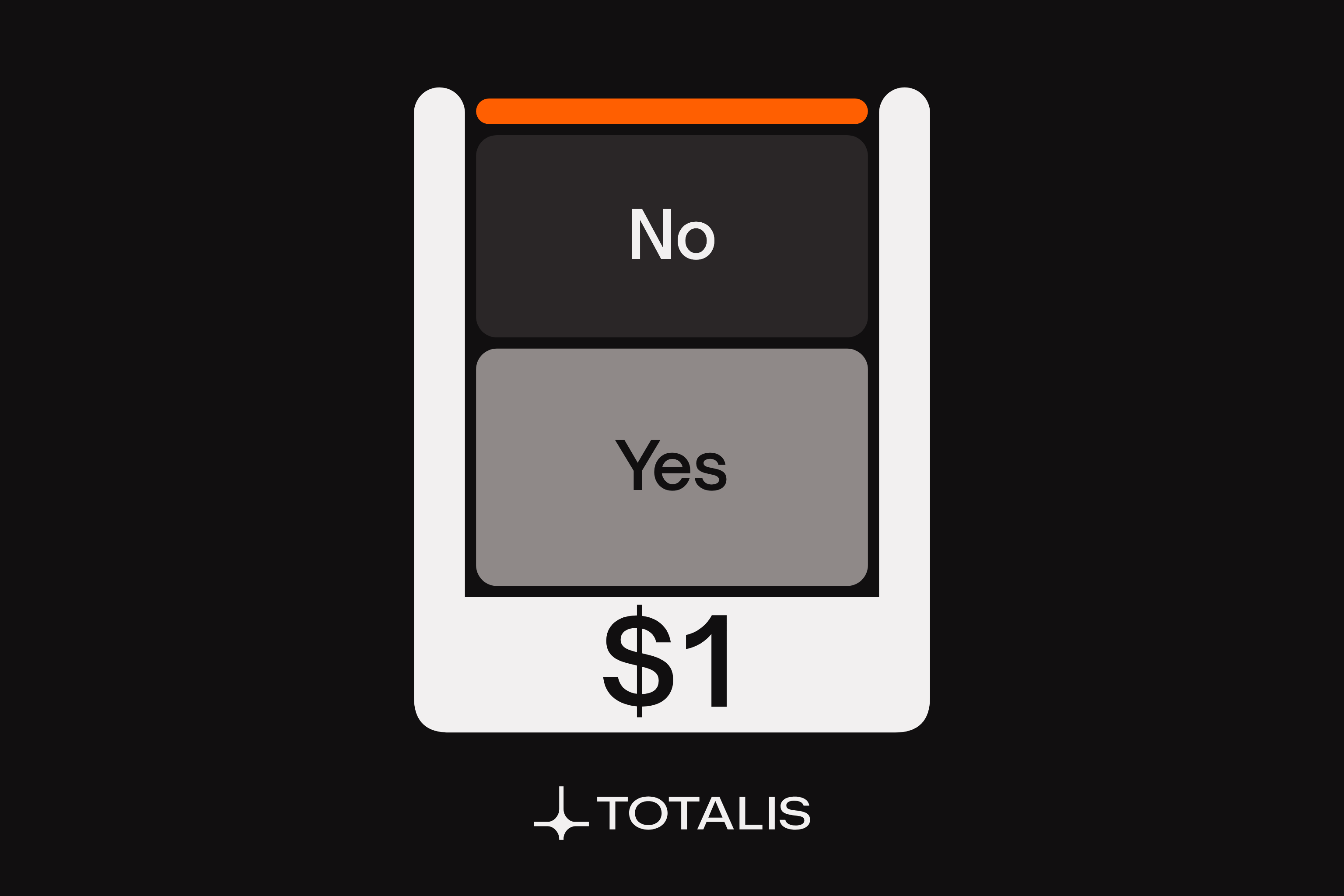
Prediction market arbitrage means buying every outcome of an event, on one venue or across several, for less than the $1 the winning share will pay. It happens: one study estimates that about $40 million was made this way on Polymarket in a year. But the gaps are small, they last seconds, and fees usually eat them. On 11 November 2026 we read ten NBA games on Polymarket and Hyperliquid's HIP-4 about every three minutes for an hour. The two cheapest sides cost less than $1 in 31 of 360 cross-venue checks, and none of them made money after fees. Adding Kalshi's prices gave 133 of 1,080 checks under $1 and still none profitable.
Contents
How does prediction market arbitrage work?#
Every complete set of outcomes pays exactly $1 at settlement: Yes or No, team A or team B, one winner out of a field. If you can buy the whole set for less than $1, you lock in the difference whatever happens. If you can sell the whole set for more than $1, the same works in reverse. There are three places to look:
| Type | What you buy | It pays if |
|---|---|---|
| Same market | Yes and No on one outcome | Yes ask + No ask is under $1 |
| Multi-outcome | Yes on every outcome of an event | The Yes asks add up to under $1, or the Yes bids to over $1 |
| Cross-venue | One side on one venue, the other side on another | The two asks add up to under $1 |
A 2025 study of Polymarket by Saguillo, Ghafouri, Kiffer and Suarez-Tangil calls the first two "market rebalancing" arbitrage and adds "combinatorial" arbitrage across related markets. Reading the on-chain order book history of markets that resolved from April 2024 to April 2025, it puts the profit actually extracted at about $40 million. It deducts no trading fees, because Polymarket charged none then.
"Under $1" has to mean after fees. A taker pays a fee on each leg, so the gap must beat the sum of both fees:
| Pair, 100 shares each side | Fee at 50/50 | Fee at 30/70 |
|---|---|---|
| Polymarket + HIP-4 | $1.39 | $1.19 |
| Kalshi + Polymarket | $3.00 | $2.52 |
| Kalshi + HIP-4 | $1.89 | $1.61 |
Polymarket charged all ten games 0.05 × shares × p × (1 − p), the sports rate on its fee page, though some of its markets carry a lower rate, such as 0.03 on the NBA title event below. Hyperliquid charges nothing to open an outcome position and charges when it settles, but that page publishes no rate table for outcome markets, and its HIP-4 overview still says outcome fees are zero. The $0.14 per 100 winning shares is what we saw one base-tier wallet pay on each of four winning settlements in markets from the same deployer as these games, three NBA games on 11 November and an NFL game on 10 November; applying it to every pair here is our assumption.
Kalshi's taker fee is 0.07 × contracts × p × (1 − p), per its fee schedule, at the $0.0001 precision its fee rounding docs apply to members who trade with it directly; members clearing through a broker are rounded to the cent.
Fee formulas are in Kalshi fees and Polymarket fees.
Can you arbitrage Polymarket and Kalshi? A worked example#
You can try; on 11 November 2026 the prices didn't allow it. The closest pair between Polymarket and HIP-4 was the Toronto Raptors v Boston Celtics game. At 10:40 UTC, HIP-4 sold the Raptors at 0.28637 and Polymarket sold the Celtics at 0.71:
| Step | HIP-4, Raptors | Polymarket, Celtics | Total |
|---|---|---|---|
| Ask | 0.28637 | 0.71 | 0.99637 |
| Cost of 100 shares | $28.64 | $71.00 | $99.64 |
| Fee | $0.14 if Toronto wins (assumed rate) | $1.03 when you buy | $1.03 to $1.17 |
| Pays at settlement | $100 if Toronto wins | $100 if Boston wins | $100.00 |
| Result | −$0.81 if Toronto wins, −$0.67 if Boston wins |
The gap was 0.36 cents a pair; the fees were nearly three times that.
Kalshi's book showed a wider gap on the same game. At 10:07 UTC Kalshi sold the Raptors at 0.28 and Polymarket the Celtics at 0.71, a total of 0.99. Buying 100 of each cost $99.00 plus $1.4112 in Kalshi fees and $1.0295 at Polymarket, $2.4407 in all: a $1.44 loss. Those two prices were still there at 11:03 UTC, by then about 985 contracts deep on Kalshi, so a gap that fees make unprofitable can sit untouched for an hour.
The least bad pair involving Kalshi came at 10:11 UTC: Kalshi's Raptors at 0.28 with the Celtics on HIP-4 at 0.71141, 0.86 cents under $1, a $0.69 loss per 100 pairs after Kalshi's $1.4112 fee and Hyperliquid's assumed $0.14.
Across the hour:
| Games, 11 November 2026 | Snapshots | Cross-venue checks | Under $1 before fees | Profitable after fees |
|---|---|---|---|---|
| 10 NBA games, Polymarket and HIP-4 | 18, about every 3 minutes from 10:03 to 11:03 UTC | 360 | 31 | 0 |
| The same games with Kalshi added | 18, same times | 1,080 | 133 | 0 |
A cross-venue check is one game and one ordered pair of venues: team A on one, team B on another. The prediction market odds guide shows the same books from a buyer's side.
This matches published research. A study of Polymarket's NBA markets by Cheng, Yang and Zou, built from over 75 million order book snapshots across 173 games, found only 7 executable single-market opportunities during play, lasting a median 3.6 seconds. Opportunities across related markets were more common, 290 episodes with a median return of 101 basis points, but 76.9% of them were limited to about 14.8 shares.
What about Yes and No on the same venue?#
On a single venue, fees closed the gaps too:
- One market. HIP-4 merges the Yes and No books of each outcome into one order book, so a Yes ask and a No ask added up to between $1.00001 and $1.0070 across these games. On Polymarket the two asks added up to $1.01 on every game. On Kalshi they added up to $1.00 to $1.02.
- Multi-outcome, Polymarket. On NBA: 2027 Champion, 24 of the 30 teams had a Yes bid at 10:06 UTC, and those bids added up to $1.023. Every 1 pUSD splits into a Yes and a No share of one team, and in Polymarket's negative risk markets that No converts into one Yes share of every other outcome, so $1 buys a full set of Yes shares. Selling the 24 into their bids brings in $1.023, but this market's 0.03 fee rate costs 2.74 cents across those sales: a loss of 0.44 cents a set, at most 91 sets deep. The event also holds placeholder outcomes and an "Other", which Polymarket's docs tell traders to leave alone.
- Multi-outcome, HIP-4. On England v Croatia in the Nations League, the Yes asks for England, the draw and Croatia added up to 0.9998 at 10:04 UTC. The winning share pays a $0.0014 fee at settlement, so the set loses 0.12 cents, and the question also carries a fallback outcome with no book that none of the three covers.
Sums under $1 are not always arbitrage. The HIP-4 NBA title question names eight teams whose Yes asks added up to 72 cents; the other 22 teams sit in the question's fallback outcome, which pays if any of them wins (NBA prediction markets).
Why "risk-free" arbitrage isn't#
A cross-venue pair only pays $1 if both venues settle the same way. They often don't have to. Here are the rules for the Knicks v Cavaliers game, scheduled for 00:00 UTC on 12 November 2026, from Kalshi's market, Polymarket's and the HIP-4 market:
| If the game | Kalshi | Polymarket | HIP-4 |
|---|---|---|---|
| Is played as scheduled | The result | The result | The result |
| Starts within 48 hours | The result | The result | The result |
| Is moved to 15 November | "A fair price" | 50-50 | The result, if established by 19 November |
| Is moved past 19 November or cancelled | "A fair price" | 50-50 | 0.5 |
Say you hold the Knicks on Polymarket and the Cavaliers on HIP-4, and the game moves to 15 November and the Knicks win. Polymarket pays 50 cents and HIP-4 pays nothing: 50 cents back on a pair that cost about $1. Kalshi's rules don't say what its "fair price" would be, so a pair with Kalshi on one side has no known value in that case at all. Polymarket's 50-50 cutoff, 11:59 PM ET on 13 November, also falls five hours after Kalshi's 48 hours run out.
Other costs that a price gap doesn't show:
- Legging. Your first order fills and the second price moves before you send it. At 10:40 UTC the Raptors at 0.28637 on HIP-4 were good for 104 shares.
- Time. Money sits in both venues until both settle. Kalshi's market FAQs say most markets settle within about 3 hours; Polymarket's UMA resolution takes about 2 hours if nobody disputes the proposal, longer if someone does.
- Moving money. Kalshi holds dollars, Polymarket pUSD and Hyperliquid USDC. Deposits, withdrawals and bridges can cost more than the gap (how to withdraw from Polymarket).
- Wording. Two markets with the same title can resolve on different sources or times. Read the rules, not the headline.
Is arbitrage allowed on Polymarket?#
Yes, as far as its rules go. Polymarket's terms of use, effective 11 August 2026, don't mention arbitrage. They prohibit wash trading, spoofing, front-running, orders that don't change who owns a position, manipulative trading, and using a VPN to get around location limits.
Two data rules in the same terms matter for bots. First, professional firms that work in capital markets, such as prop traders, market makers and hedge funds, and market data distributors may not access or use Polymarket's data "directly or through an API, or any other means, including on-chain" without Polymarket's written agreement. Second, everyone is barred from using "data mining tools, robots, crawlers, or similar data gathering and extraction tools to scrape" the site. Trading automatically through Polymarket's own API is a different thing: its docs walk traders through placing orders and running a market-making system from their own account.
Kalshi's market integrity rules likewise target fraud, manipulation and insider trading rather than arbitrage.
Is arbitrage illegal in the US? Neither venue names it as prohibited conduct, but a platform's rules don't settle what the law allows: that depends on federal and state law where you are, which we don't assess here. In practice the first limit is where you may trade. Polymarket's terms bar the US, the UK, France, Germany and others from its international exchange, and Kalshi's Member Agreement bars the UK, Canada, Australia, France and others. In the US, the pair open to traders is Kalshi and Polymarket US; is Polymarket legal and is Kalshi legal go through the details. This isn't legal advice.
Polymarket bots, Kalshi bots and API rate limits#
The gaps that pay last seconds, so the people who catch them run bots. "AI bots" for prediction markets are a rising search, but a bot written by a language model faces the same fees and limits as any other:
| Venue | Reading prices | Sending orders |
|---|---|---|
| Kalshi | Basic tier: 200 tokens a second, most requests 10 tokens, so about 20 reads a second | 100 tokens a second, about 10 orders a second; higher tiers by volume |
| Polymarket | CLOB and Gamma limits listed only as "Standard" for most builders, with no published numbers we found; its terms let it change limits without notice | CLOB orders fall under the same API limits. Separately, relayer transactions for gasless wallet operations, such as splits and conversions, are capped at 100 a day for unverified builders, and unlimited for traders on their own wallet with a Relayer API key |
| Hyperliquid | 1,200 request weight a minute per IP; an order book read weighs 2 | One action per dollar traded since the address was created, after a 10,000-request start |
| Totalis | Market reads need no key | 30 Combo quote requests a minute per account |
Sources: Kalshi's rate limits and tiers, Polymarket's builder tiers, Hyperliquid's rate limits and the Totalis limits and fees page. Hyperliquid's address limit matters for a bot that mostly quotes and cancels: it runs out unless the bot also trades. Kalshi answers an over-limit request with 429 and no Retry-After. Our own reader lost 2 of its 20 rounds to a 429 from Hyperliquid, though it sent only ten order book reads a round: Hyperliquid's budget counts every request from one IP address together, and other programs on our machine were using it too. The API guides go deeper: Kalshi API, Polymarket API and the Hyperliquid API.
Even with fast code, profit is not assured. The gaps we saw were smaller than the fees, and in the NBA study above most of the gaps worth taking were about 15 shares deep. None of this is financial advice.
Where Totalis fits#
Totalis trades Hyperliquid's HIP-4 outcome markets as singles on the HyperCore order book and as Combos of 2 to 5 legs. A Combo is priced by request for quote: makers compete to quote its payout and take the other side. Bots can trade on their own Totalis account with an API key, and makers quote Combos through the same API (build on Totalis). Totalis is not available to US persons, and signing up takes an invite code. If you can use it, open the Totalis app and compare its HIP-4 prices with Kalshi's and Polymarket's yourself.
How we counted#
- Prices. For each of the ten NBA games on 11 November 2026 (US time), we read Polymarket's Gamma and CLOB APIs and Hyperliquid's
l2Bookinfo request, about every 3 minutes from 10:03 to 11:03 UTC. Two of the 20 rounds failed on a Hyperliquid429and are left out. - Kalshi. In the same rounds we read Kalshi's order books for the same games. Kalshi asks are 1 minus the best opposing bid, taking the cheaper of buying Yes on one team or No on the other, and fees use the $0.0001 precision Kalshi applies to direct members.
- Checks. For each snapshot and game, we added team A's best ask on one venue to team B's best ask on another, for each ordered pair of venues, and costed 100 shares of each at taker fees. Every HIP-4 pair carries an assumed $0.14 settlement fee, the rate we observed on one wallet's settlements, not a published one.
- Same venue. Polymarket's NBA title event at 10:06 UTC and HIP-4's England v Croatia and NBA title questions at 10:04 UTC, from the same APIs.
Sources and further reading#
- Saguillo, Ghafouri, Kiffer and Suarez-Tangil, Unravelling the Probabilistic Forest: Arbitrage in Prediction Markets, accessed 2026-11-11
- Cheng, Yang and Zou, Arbitrage Analysis in Polymarket NBA Markets, accessed 2026-11-11
- Polymarket terms of use, accessed 2026-11-11
- Polymarket negative risk markets, accessed 2026-11-11
- Kalshi fee schedule, accessed 2026-11-11
- Kalshi rate limits and tiers, accessed 2026-11-11
- Hyperliquid rate limits and user limits, accessed 2026-11-11
Related: can you make money on prediction markets?, list of prediction markets, prediction market volume, Hyperliquid vs Polymarket vs Kalshi.
This article is for informational purposes only and is not financial advice. Prediction market positions can lose their entire value. Availability of markets and features depends on your jurisdiction and each platform’s terms.