Which prediction market has the most volume? Kalshi vs Polymarket in numbers
12 min read
By the Totalis team. We build the combo platform for prediction markets on Hyperliquid.
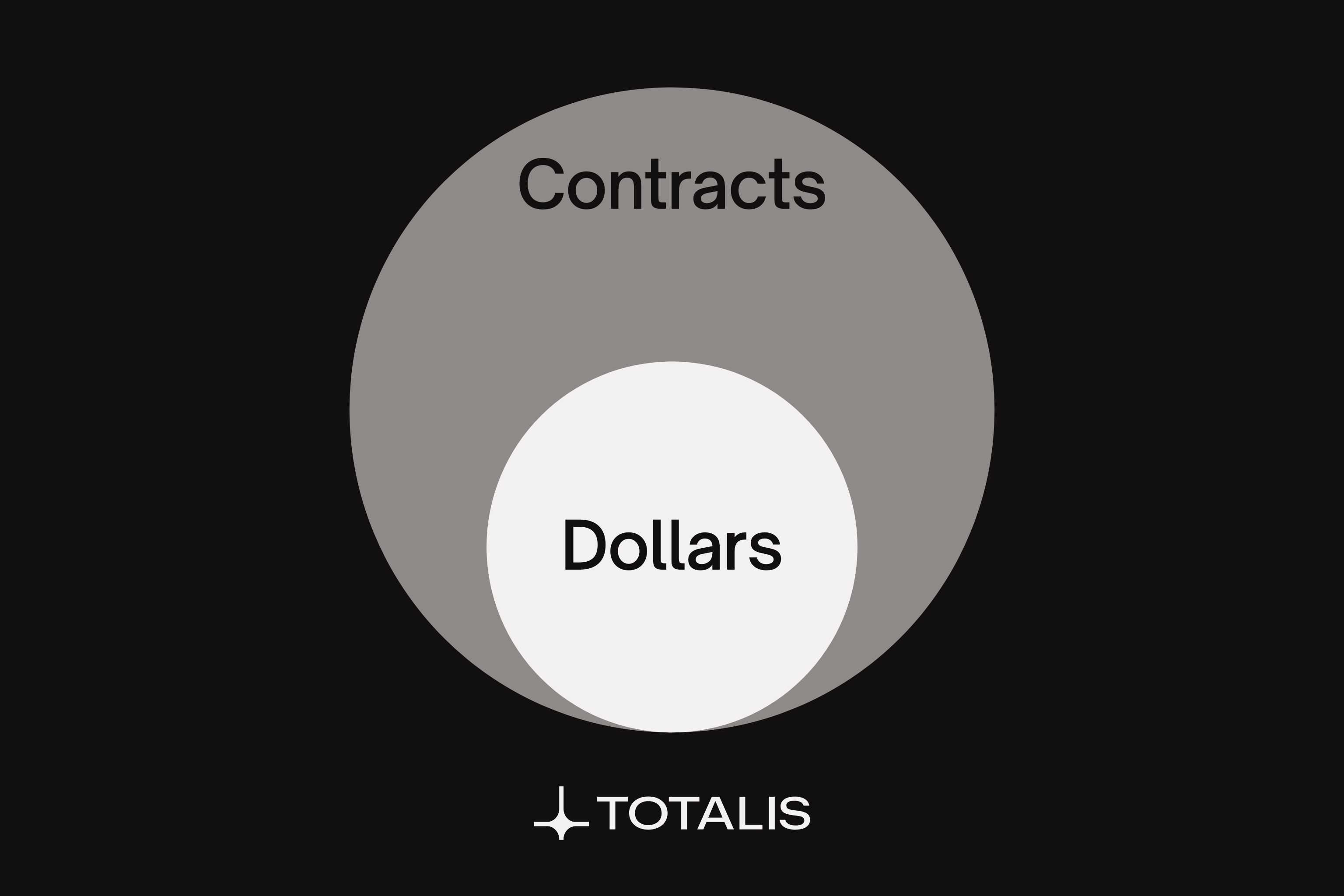
Kalshi has the most volume of any prediction market. In October 2026 it traded $16.9 billion, 2.8 times the $6.1 billion that Polymarket's two exchanges traded together. Counted in contracts instead of dollars, as Kalshi itself counts it, the lead looks wider: 98.2 billion contracts against 20.4 billion. Both numbers are correct, and the gap between them is why volume figures for the same venue can differ five times over. This page takes each venue's figure from its own data where it publishes one, counts each trade once in dollars and in contracts, and dates every figure. Totalis, which publishes it, is a trading app on Hyperliquid's much smaller HIP-4 markets.
Contents
Which prediction market has the most volume?#
Kalshi, by a wide margin. These are the four venues we could check against their own published trade data, for the last complete calendar month:
| October 2026 | Dollars traded | Contracts traded | Average price per contract | Source |
|---|---|---|---|---|
| Kalshi | $16.88 billion | 98.15 billion | 17 cents | DefiLlama, from Kalshi's daily trade and market reports |
| Polymarket US | $3.43 billion | 14.91 billion | 23 cents | Polymarket's data page |
| Polymarket International | $2.69 billion | 5.44 billion | 49 cents | Polymarket's data page |
| Hyperliquid HIP-4 | $74.6 million | 183.8 million | 41 cents | DefiLlama |
Every row counts each trade once, but each venue prices that trade its own way. Kalshi's dollars are contracts times the trade price in its report. Polymarket's data page counts only the taker's side, by the cash size of the trade. DefiLlama's HIP-4 figure halves the value of every fill, so a match between a Yes buyer and a No buyer counts differently than it would in a taker-only count (see HIP-4 volume). "Contracts traded" values every contract at the $1 it pays if it wins. Of the four venues' combined October dollars, Kalshi had 73.2%, Polymarket US 14.9%, Polymarket International 11.6% and HIP-4 0.3%. In contracts Kalshi's share was 82.7%.
Kalshi's row comes from DefiLlama's Kalshi adapter, which sums Kalshi's own daily trade reports. We checked it against Kalshi's raw files for ten trading dates between October 2025 and November 2026, and it matched within $5 on each (see how we counted). Polymarket's rows come from Polymarket's data page, which covers both of its exchanges. Polymarket International is the crypto exchange at polymarket.com; Polymarket US is the app it runs as a CFTC-designated contract market. What is Kalshi and what is Polymarket explain the two companies, and the list of prediction markets covers the rest.
Is Kalshi or Polymarket bigger?#
Kalshi, in every month since April 2026, by a margin that grew through September. For most of the time before that Polymarket was the larger venue in dollars.
| Month, 2026 | Kalshi | Polymarket US | Polymarket International | Kalshi vs both Polymarket exchanges |
|---|---|---|---|---|
| January | $3.76B | $0.14B | $3.54B | 1.02x |
| February | $4.19B | $0.14B | $3.75B | 1.08x |
| March | $5.19B | $0.35B | $4.97B | 0.98x |
| April | $5.42B | $0.61B | $4.20B | 1.13x |
| May | $6.16B | $0.85B | $3.25B | 1.50x |
| June | $9.64B | $1.85B | $4.22B | 1.59x |
| July | $12.30B | $2.23B | $3.57B | 2.12x |
| August | $11.43B | $1.68B | $2.41B | 2.80x |
| September | $13.57B | $2.57B | $2.17B | 2.86x |
| October | $16.88B | $3.43B | $2.69B | 2.76x |
Dollars traded. Kalshi from DefiLlama, by Kalshi trading date. Polymarket from its data page, by US Eastern day. Read on 11 November 2026.
Over the full year 2025, Polymarket International traded $11.28 billion and Kalshi $10.53 billion on the same sources. Polymarket was bigger every month from January to August 2025. Kalshi passed it in September 2025, with $1.34 billion against $0.78 billion. In March 2026 Polymarket's two exchanges were briefly ahead again, $5.32 billion to $5.19 billion; since April Kalshi has led every month.
Inside Polymarket, the US exchange has overtaken the international one. Polymarket US traded more than Polymarket International in dollars for the first time in September 2026 ($2.57 billion to $2.17 billion) and again in October and in November so far. Hyperliquid vs Polymarket vs Kalshi compares the venues on fees, markets and access.
How much volume do Kalshi and Polymarket trade each day?#
From 3 to 10 November 2026, Kalshi traded $556 million to $822 million a day and Polymarket's two exchanges together $153 million to $268 million. Both companies publish their days on US Eastern time, so this table compares like with like:
| Day (US Eastern), 2026 | Kalshi | Polymarket US | Polymarket International |
|---|---|---|---|
| Tuesday 3 November | $770.1M | $120.5M | $129.3M |
| Wednesday 4 November | $662.1M | $107.9M | $99.6M |
| Thursday 5 November | $555.9M | $95.3M | $75.7M |
| Friday 6 November | $585.8M | $102.6M | $72.9M |
| Saturday 7 November | $740.5M | $144.4M | $101.5M |
| Sunday 8 November | $821.9M | $151.5M | $116.3M |
| Monday 9 November | $559.0M | $97.4M | $55.8M |
| Tuesday 10 November | $601.2M | $97.5M | $61.1M |
Dollars traded. Kalshi summed from its own trade files; Polymarket from its data page, read on 11 November 2026.
Kalshi, Polymarket US and Polymarket International all had their busiest day of the seven days to 10 November on Sunday 8 November. The first row, Tuesday 3 November, was the day of the US midterm elections, and it was Polymarket International's busiest day in the table. Polymarket's data page has the same figures by day, week and month.
Why do prediction market volume figures differ?#
Because dashboards count different things and label them all "volume". For one Kalshi day, 9 November 2026, three public figures exist: Kalshi's own report says 3,130,578,348 contracts, DefiLlama says $558,974,302, and The Block's chart shows $3,130,578,348.03, which is the contract count with a dollar sign. These are the reasons figures differ.
Dollars or contracts#
A contract pays $1 if it wins. Kalshi's headline volume counts contracts, so a $10 trade at 25 cents counts as 40. Polymarket's data page offers both and explains the difference: dollars "measure the cash size of a trade", and contracts are the dollars divided by the price. A chart in contracts can therefore be several times its chart in dollars.
| October 2026 | In dollars | In contracts | Ratio |
|---|---|---|---|
| Kalshi | $16.88 billion | 98.15 billion | 5.8x |
| Polymarket US | $3.43 billion | 14.91 billion | 4.3x |
| Polymarket International | $2.69 billion | 5.44 billion | 2.0x |
Headlines mix the two. "Polymarket US nears $15 billion in monthly trading volume" reports October's contract count, as the article itself explains further down; in dollars the month was $3.43 billion. The Block describes its chart as daily USD volume, and its figures for 9 November match Kalshi's and Polymarket US's contract counts for that day to the cent.
Combos make contracts cheap#
The ratio has grown because of Combos, which join several outcomes into one contract. A Combo of long shots can trade for a cent or two, so a small amount of money buys a large number of contracts. Kalshi's Combos trade under tickers that begin KXMVE. In Kalshi's trade files for 4 to 10 November 2026, they were 70.8% of contracts and 17.4% of dollars, at an average of 3.9 cents. Polymarket US Combos, which trade under crossd- and caoc- symbols per its Combos API docs, were 63.3% of its contracts and 17.7% of its dollars over about the same week, at 6 cents on average.
Cheap Combos are why contract counts can far exceed dollar volume. Kalshi's average contract was 17 cents in October 2026, against 39 cents in January, and its lead over Polymarket was 4.8 times in contracts but 2.8 times in dollars. If you want to compare money traded, use dollars. Prediction market combos compares the Combo products themselves.
One side or both sides#
Every trade has a buyer and a seller. Count both and the volume doubles. Kalshi counts each pair of Yes and No positions as a single contract, a rule it adopted on 24 December 2021 and applied to its history. Polymarket's data page counts only the taker's side, in dollars and contracts alike. DefiLlama's Polymarket adapter halves Polymarket International's on-chain fills so each trade counts once.
Hyperliquid's HIP-4 shows how far this can go. Its order book can match a buyer of Yes with a buyer of No, and dashboards count those matches differently: on 9 November 2026 one showed $15.6 million and DefiLlama $9.7 million for the same day. HIP-4 volume works through that case.
Which day#
Kalshi's trade files start each day at midnight US Eastern, and so does Polymarket's data page. DefiLlama uses UTC days for on-chain venues, and its Kalshi series files each trading date under the following day. Polymarket US's exchange files run from 5 p.m. to 5 p.m. Eastern. For 9 November 2026 that gives three Polymarket US figures: $97.4 million on the data page's Eastern day, $100.8 million for the UTC day and $110.9 million in the file dated 9 November. Over a month the clocks barely matter.
Missing days#
Dashboards also miss data. When we summed Polymarket US from the exchange's own time-and-sales files for the 30 days to 8 November 2026, the total was $3.41 billion, while DefiLlama's Polymarket US series for the same days added up to $3.09 billion, about 9% low, because it had no figure for some days and only part of others. HIP-4 volume has the day-by-day detail.
Rewards#
Some volume is paid for. Polymarket US runs a volume incentive program that shares reward pools by taker volume on eligible contracts. Outcome, which lists most of HIP-4's busiest markets, pays liquidity rewards that go 50% to maker fills and 10% to taker fills. Kalshi's liquidity incentive program pays for resting orders, not for trades. None of the three publishes how much of its volume earned rewards.
What share of prediction market volume is sports?#
Sports is the largest category on every venue that publishes the split, but on Kalshi it was less than half of the dollars in the week we measured. Kalshi files each trade under a series, and gives each series a category. Summing Kalshi's trade files for 4 to 10 November 2026:
| Kalshi, 4 to 10 November 2026 | Share of dollars | Share of contracts |
|---|---|---|
| Sports | 43.7% | 15.6% |
| Crypto | 32.1% | 10.7% |
| Combos | 17.4% | 70.8% |
| Commodities | 4.0% | 1.3% |
| Elections | 1.6% | 1.0% |
| Everything else | 1.2% | 0.5% |
Kalshi files Combos under a category of their own, Exotics, and their legs can span categories, so they are a separate row. Crypto was nearly a third. One series, Bitcoin's price in 15-minute windows, was 24.2% of Kalshi's dollars that week, more than any other series. The largest sports series, NBA game winners, was 4.1%. Elections were small that week but not on election day itself: on 3 November they were 27.4% of Kalshi's dollars. Bitcoin price prediction markets covers the crypto markets.
Polymarket US publishes every trade with a symbol whose prefix names the contract type. In its files for 4 to 10 November 2026 (trades from 5 p.m. Eastern on 3 November to 5 p.m. on 10 November), single sports contracts were 54.5% of dollars, crypto price contracts 24.9%, Combos 17.7% and everything else, mostly elections, 2.9%. HIP-4 was 95% sports and esports by 24-hour volume on 10 November 2026, per HIP-4 volume. Best prediction markets for sports compares the venues for sports traders.
How big was the prediction market industry in 2025?#
Kalshi and Polymarket together traded $21.9 billion in 2025, or 51.5 billion contracts. From January to October 2026 the same venues, plus HIP-4, traded $137.5 billion, more than six times all of 2025 in ten months.
| Venue | 2025, dollars | 2025, contracts | January to October 2026, dollars |
|---|---|---|---|
| Kalshi | $10.53 billion | 24.06 billion | $88.56 billion |
| Polymarket International | $11.28 billion | 27.36 billion | $34.77 billion |
| Polymarket US | $0.04 billion | 0.09 billion | $13.86 billion |
| Hyperliquid HIP-4 | Not launched | Not launched | $0.31 billion |
| Total | $21.85 billion | 51.51 billion | $137.49 billion |
Same sources as the monthly table. Polymarket US's first reported volume on its data page is $1,070 on 30 October 2025, and HIP-4 launched on 2 May 2026. These totals leave out every other venue, so treat them as a floor for the industry, not a measure of all of it.
Which other prediction markets have volume?#
Outside Kalshi and Polymarket the next venues are much smaller. DefiLlama's prediction market list, read at 10:00 UTC on 11 November 2026, showed these 30-day totals:
| Venue | 30-day volume on DefiLlama |
|---|---|
| Kalshi | $17.78 billion |
| Polymarket US | $2.98 billion |
| Polymarket International | $2.72 billion |
| Predict Fun | $404 million |
| Opinion | $217 million |
| OmenX | $192 million |
| SX Bet | $138 million |
| Hyperliquid Outcomes (HIP-4) | $125 million |
DefiLlama's Polymarket US figure is the series we found about 9% low above. Each row follows that venue's adapter, so the smaller venues' figures are not checked against their own data here.
Where HIP-4 and Totalis fit#
Hyperliquid's HIP-4 is a small venue next to these two: $74.6 million in October 2026, 0.4% of Kalshi's dollars. It is growing fast, and on 9 November 2026 it traded a record $9.74 million, more than 16% of Polymarket International's day. HIP-4 volume tracks it daily and Hyperliquid vs Polymarket vs Kalshi compares the three venues on more than size.
Totalis is an app for trading HIP-4 markets. A single is a trade on Hyperliquid's order book and counts toward HIP-4's volume. A Combo of 2 to 5 outcomes is quoted by market makers and held in the Totalis vault on HyperEVM, so it is not in HIP-4's figures. How a Combo settles has the rules and the Totalis fees and limits page lists every charge. Totalis is not available to US persons, and sign-up takes an invite code. If you are outside the US, the Totalis app is where to start.
Volume is not depth. A venue with more volume usually has more resting orders, but check the spread and size on the market you want before you trade. This page is information, not financial advice.
How to check prediction market volume yourself#
| Venue | Primary source | What it counts |
|---|---|---|
| Kalshi | Daily trade and market reports on its trade data page, as trade_data and market_data files | Every trade with contracts and price; daily contracts per market. Days start at midnight US Eastern |
| Polymarket, both exchanges | Polymarket's data page | Taker side only, in dollars and contracts, by US Eastern day, week or month |
| Polymarket US | Time-and-sales files and the daily market report | Every trade with price and quantity; daily contracts per market |
| Hyperliquid HIP-4 | Hyperliquid's own data, summed by DefiLlama and others | See HIP-4 volume for the counting rules |
To pull these into code, the Kalshi API guide and Polymarket API guide cover the trading APIs, and prediction market odds and payouts explains why a contract's price is its implied chance.
How we counted#
- Kalshi, dollars and contracts. DefiLlama's daily volume and notional volume for Kalshi, read on 11 November 2026. Its adapter takes contracts times price from Kalshi's trade report and contracts from its market report, and files each trading date under the next day; we moved it back a day.
- Kalshi, checked against Kalshi. We downloaded Kalshi's
trade_datafiles for 15 October 2025, 16 March 2026, 15 July 2026 and 3 to 10 November 2026, and summed contracts and contracts times price. Both sums matched DefiLlama to the dollar on 15 October 2025, 15 July 2026 and 3 to 9 November 2026, and within $5 on 16 March 2026. 10 November is from the file alone, as DefiLlama did not have it yet. Categories are the ones Kalshi gave each series on 11 November 2026. - Polymarket. Polymarket's data page,
https://data.polymarket.com/api/volume, read on 11 November 2026, monthly and daily, both venues. It counts the taker side only and dates by US Eastern time. - Polymarket US by contract type. The exchange's time-and-sales files dated 4 to 10 November 2026, summed as price times quantity per symbol prefix:
crossdandcaocare Combos,cpccrypto prices, andaec,asc,tsc,atc,astatc,tecand similar sports. - HIP-4. DefiLlama's Hyperliquid Outcomes series, UTC days.
- Not covered. Venues that publish no daily trade data. DefiLlama revises its series, so a figure read later can differ. We will update this page with each month's totals.
Sources and further reading#
- Kalshi, trade data, accessed 2026-11-11
- Kalshi, notice on volume and open interest units, accessed 2026-11-11
- Polymarket, data page, accessed 2026-11-11
- Polymarket US, time and sales files, accessed 2026-11-11
- DefiLlama, Kalshi adapter, accessed 2026-11-11
- DefiLlama, prediction markets, accessed 2026-11-11
- The Block, Polymarket, Polymarket US and Kalshi volume, accessed 2026-11-11
Frequently asked questions#
What does volume mean on Kalshi?#
Kalshi's published volume is the number of contracts traded, with a Yes and No pair counted as one contract. Since each contract pays $1 if it wins, the number reads like dollars, but the money that changed hands is contracts times price. In October 2026 that was 17 cents per contract on average.
What does volume mean on Polymarket?#
Polymarket's data page shows both dollars and contracts, counting only the taker's side of each trade. Check which measure a chart uses before you compare it with Kalshi.
Is prediction market volume the same as money deposited?#
No. Volume counts every trade, so the same dollar can be traded many times in a day. It says nothing about deposits, open interest or how many people trade.
This article is for informational purposes only and is not financial advice. Prediction market positions can lose their entire value. Availability of markets and features depends on your jurisdiction and each platform’s terms.